BLOG Perfomax
Latest Post
---------------
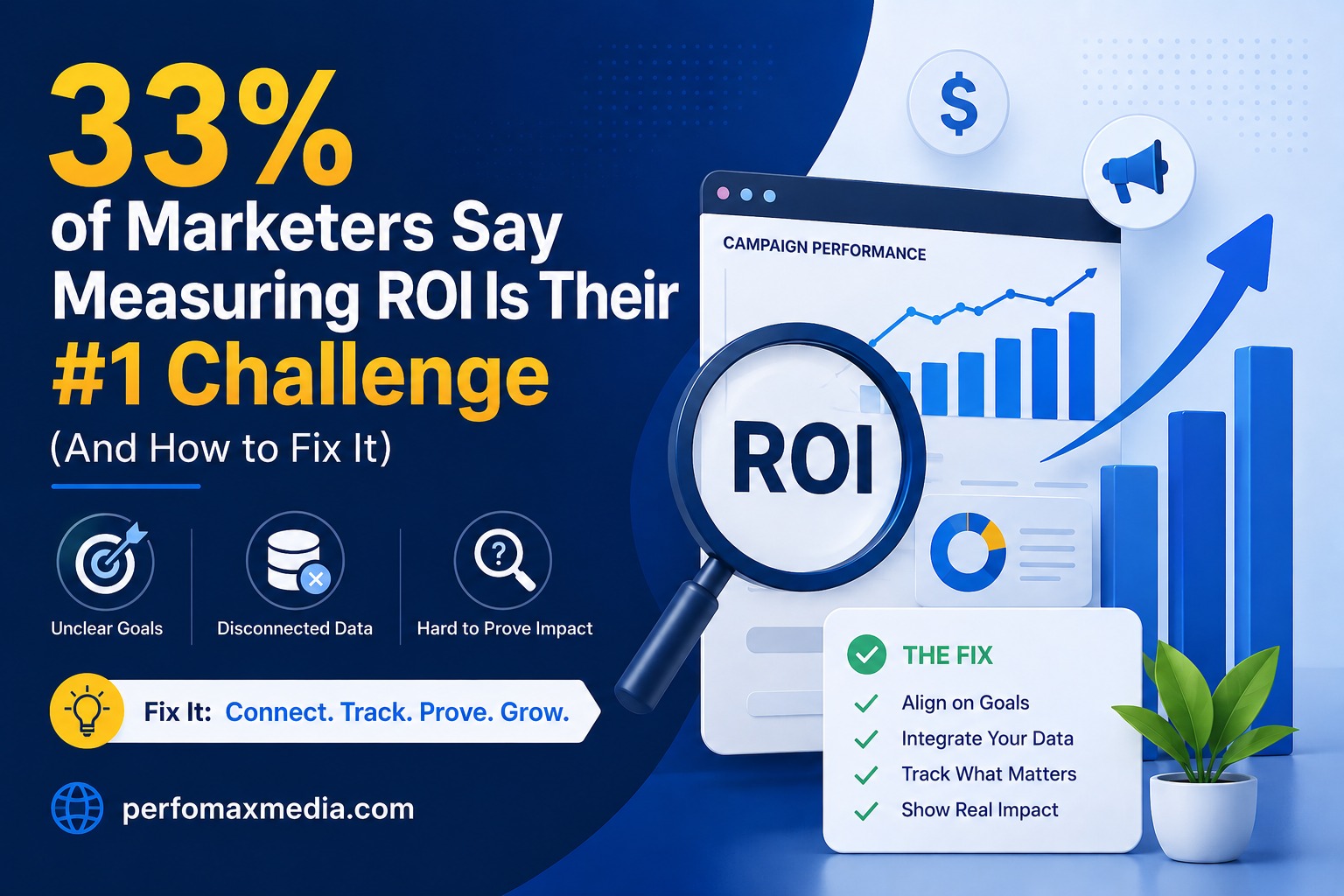
Why 33% of Marketers Say Measuring ROI Is Their 1 Challenge
2026-06-01You're investing in Google Ads, running social media campaigns, publishing blogs, and sending email newsletters. But when leadership asks 'Is our marketing working?', the answer is uncomfortably vague. You're not alone.
For brands like TBPL in India’s real estate market and Marquway in the UAE’s service consultancy space, this challenge is not just about analytics — it’s about making smarter decisions with every rupee (?) spent on digital marketing.
1. Why ROI Measurement Has Become So Hard
The marketing landscape has fragmented dramatically. Where once a brand could measure TV + print + billboard, today's marketer juggles Google Ads, Meta, LinkedIn, SEO, email, WhatsApp, content, influencers — each with its own attribution model and reporting dashboard.
The Attribution Problem
A buyer searches for a property on Google, sees a retargeting ad on Instagram, receives an email, and then books a site visit via WhatsApp. Which channel gets the credit? This multi-touch journey — now the norm — makes single-channel attribution dangerously misleading.
Key Insight: The fragmentation of ad channels and data sources has made cross-channel measurement a business necessity, not a luxury.The Cookie Deprecation Challenge
Third-party cookies — the backbone of cross-site tracking — are being phased out across all major browsers in 2026. Brands without a first-party data strategy are flying blind.
2. The Real Cost of Not Measuring ROI Properly
The consequences go far beyond a confusing dashboard. Here's what brands lose when measurement breaks down:| Gap in Measurement | Real Estate Impact (TBPL) | Consultancy Impact (Marquway) |
|---|---|---|
| Budget on wrong channels | Spending on portals with low enquiry quality | LinkedIn neglected despite 60% lead share |
| High-performers paused | Top Google campaigns stopped due to 'low visibility' | Organic content budget cut mid-campaign |
| Marketing–Sales misalignment | Sales team unaware of ad-driven leads | Proposals sent without marketing context |
| Can't justify budget | No data to defend ?10L+ quarterly spend | No ROI proof for ?15L+ monthly retainers (approx. AED 65K) |
3. ROI Stats You Need to Know — At a Glance
Before building your measurement strategy, understand where the industry stands today:| Statistic |
|---|
| Marketers who cite ROI as #1 challenge |
| Global digital ad spend 2026 (India: ?5.5 lakh crore+) |
| Marketers reporting search/display as top ROI channel |
| Marketers maintaining/increasing search spend |
| Consumers who check website first before buying |
| ROI uplift from tracking lead quality & MQL rate |
| Avg. automation ROI for measurement-strong brands |
| Time to recoup measurement investment |
4. Case Studies: Getting ROI Measurement Right
Case Study: TBPL Context — Real Estate, India
Case Study: Marquway Context — UAE Consultancy
5. The 2026 ROI Measurement Framework
A 5-step approach tailored for real estate and consultancy brands:| # | Step | TBPL (Real Estate) | Marquway (Consultancy) |
|---|---|---|---|
| 1 | Define ROI Metrics | Cost-per-site-visit & visit-to-booking ratio | Cost-per-consultation & consultation-to-retainer rate |
| 2 | First-Party Data Infrastructure | CRM + website + WhatsApp in one system | CRM + LinkedIn + email platform integrated |
| 3 | Multi-Touch Attribution | Track: Search ? Instagram ? Email ? Site Visitm | Track: LinkedIn ? Email ? Call ? Proposal |
| 4 | Track Leading Indicators | Enquiry form fills, brochure downloads, site visit bookings | Whitepaper downloads, webinar signups, consultation requests |
| 5 | Report Consistently | Weekly dashboard + monthly board report | Weekly pipeline report + quarterly client ROI review |
6. Tools That Bridge the ROI Gap
The right stack doesn't have to be expensive. Here's what works at every budget level:| Tool | Best For | Cost | Key Feature |
|---|---|---|---|
| Google Analytics 4 | Website + traffic attribution | Free | Multi-touch event tracking |
| HubSpot CRM | Full funnel visibility | Free-Paid | Click-to-close lead tracking |
| Hotjar / MS Clarity | User behaviour on site | Free | Heatmaps & session recordings |
| Meta Ads Manager | Social ad attribution | Free (with ad spend) | Pixel-based conversion trackings |
| Google Ads | Search & display ROI | Free (with ad spend) | Smart bidding + conversion goals |
| Marketing Mix Modelling | Enterprise cross-channel (?10L+/month spend) | Paid/Agency | Full channel contribution model |
Conclusion
At Perfomax Media, a leading digital marketing agency in Kochi, Kerala, we know measuring marketing ROI can be challenging — but it’s no longer optional. In today’s fast-moving digital world, where India’s ad market continues to grow rapidly, successful brands understand exactly where every rupee is invested and the returns it generates. Clear ROI tracking builds smarter decisions, stronger campaigns, and long-term business growth.